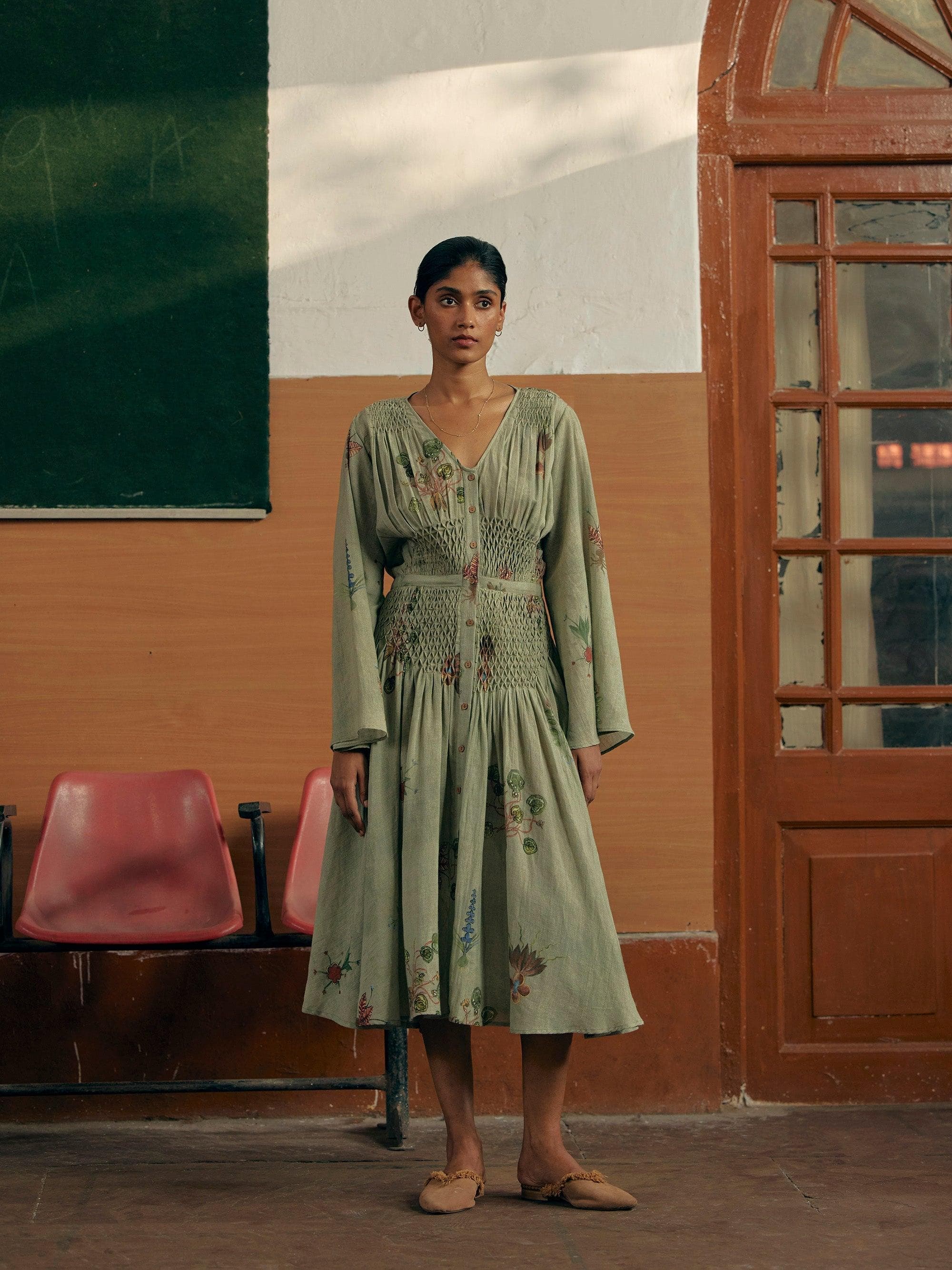
Heritage Labs is New Common's name for Indian clothing where the craft is the cloth itself: handspun, handwoven, block-printed, smocked or stitched by hand before the garment is cut, and then pushed somewhere new. Of the five Movements we sort every piece into, this is where handmade Indian clothing makes its strongest case.
That case is older than any of the studios in it. Three people in three countries made it in pieces over forty years, and Indian cloth is where the pieces fit together.
The maker
In 1880, speaking in Birmingham, William Morris gave the line that now sits on tea towels: "Have nothing in your houses that you do not know to be useful, or believe to be beautiful." In its moment it was a political statement. Morris was looking at Victorian rooms full of machine-made things with ornament stuck on afterwards, and arguing that industry had broken the link between the person who made a thing and the pleasure they took in making it. He was a poet, a dyer, a weaver and a printer, and he insisted that the way cloth was made could be seen in the cloth.
Morris dyed with madder and indigo himself, and he would have known NAMBI-KAI's More Than Blue Top at once. Every square of the green and white check at its yoke, and every purple and yellow stripe in the gathered panel below, was painted by hand onto Salem cotton in dyes made from iron and jaggery, lac, madder and myrobalan. Nothing on it was printed, and the small irregularities in the lines are how you can tell. The studio is in Chennai. Wear it over plain cream trousers, so the painting is the only pattern in sight.
The plain object
In the 1920s the Japanese philosopher Yanagi Sōetsu, with the potters Hamada Shōji and Kawai Kanjirō, gave the name mingei, art of the people, to the plain things made for daily use by makers nobody recorded. He had been moved by Korean rice bowls of the Joseon period, made in quantity by unnamed potters. His point was that beauty doesn't need self-expression. A maker who repeats a form for a lifetime puts the tradition into it, and the beauty comes out of the repetition.
Studio MAGO's Kiro Cuban Collar Shirt is that idea in a shirt. It's beige cotton printed with pale leaves and flowers, with an open collar and fine vertical pintucks running down the front beside the buttons. The print is quiet, so the tucks do the work, and you read them by the light they catch. Wear it buttoned with plain trousers; anything louder next to it hides the only thing it says.
Craft as the ground
In April 1919 Walter Gropius published the founding manifesto of the Bauhaus in Weimar, calling for "a new guild of craftsmen" without the class barrier between craftsman and artist. Every student learned a trade first. The point was that you can only push a medium you already handle well: the dyer who knows how indigo behaves is the one who can ask it to do something new.
Na by Nitya makes that argument with a brush. Jheel means lake, and the Jheel Saree is white silk organza painted by hand like a canvas: still water, a grey swan, an orange goldfish, gone over in places with hand embroidery and held inside a thin red edge. The sari is the old form, and the painting on it is new work standing on that ground, which is the Bauhaus point exactly. It comes without a blouse; wear it with a plain white one, so the lake stays the picture. It's on the studio's page with the rest of its painted saris.
Made to be handed down
Maison Madras takes the argument to children. The studio, a Chennai design house, makes children's clothes in handloom cotton, sized by age from two to eleven. Its Balloon sleeved jacket is a short wrap jacket in an aqua stripe with pink and purple running through it, lined inside in a second handloom cotton, with full sleeves in mul gathered at the wrist on ties. Children wear clothes harder than anyone and outgrow them before they wear them out, so a jacket like this tends to reach a younger cousin. That's Yanagi's everyday object, made well, in the smallest size. Buy it a size up and let it do two winters.
What to buy first
The call here is to start with the plainest of these, the Kiro shirt, because the hand shows most where nothing is competing with it. The painted top and the painted sari are a second purchase, once you know what you're looking at. None of these studios is preserving a craft under glass. They work from it, with the cloth as the ground and the new idea standing on top, and that's what the Movement means.
- New Common: a house for South Asian fashion, design and culture that begins in India. Who we are: our story.
Related: Indian fashion brands for London · 12 Indian clothing brands


