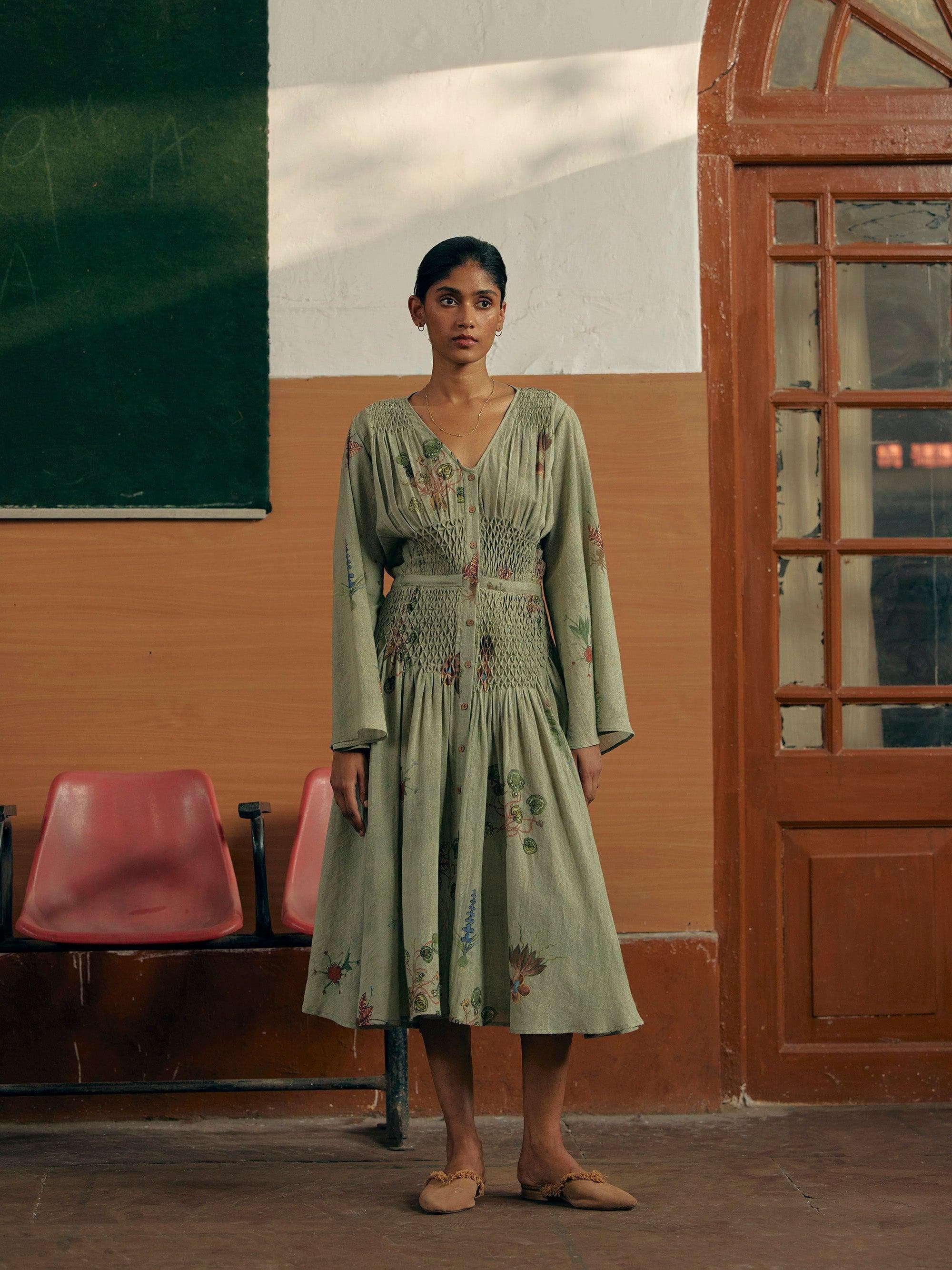
Indian independent fashion now has a home. It is called New Common. The door is open. Walk in.
Inside, you find a country that has been quietly building itself for a generation. An entire generation of brands. Workshops in dozens of cities. Two coasts and a diaspora. A density of work, a sharpness of vision, a confidence in cloth and cut and craft. The strongest creative cycle the country has produced in fashion since liberalization, and the first time it has had its own room.
The first piece you see when you walk in is a smocked linen dress called the Juliet. It comes from Cord. It costs ₹13,800. The smocking that gives the linen its three-dimensional surface was laid by hand in a workshop in Modinagar, where one brand and one community of artisans have been working in the same cloth for ten years. The Juliet sits inside Heritage Labs, the first of five rooms inside New Common. There are four more.
This is what the home looks like.
What New Common Is
New Common is the address Indian independent fashion has been waiting for, the audience for it has been waiting for, and the artisans behind it have been waiting for. It is the room where the work lives in its full context, in the language it was made in, and at the volume it has earned.
It is built around five movements: Heritage Labs, Bambai Beats, Third Culture, New Luxury, and The Utilitarian. Each movement is a way of cutting the country's fashion. By craft. By city. By hyphen. By register. By the cloth your body actually wakes up in. Each movement carries its own essay, its own canon, its own room. Brands sit inside the movement they belong to. The reader walks through the rooms.
The brands handle their own commerce on their own storefronts. New Common holds the canon. That separation is not an oversight; it is the design. It lets the editorial be sharp because the editorial does not need to sell. It lets brands stay true to themselves because they do not need an intermediary. The cultural argument lives at New Common. The transaction happens at the brand's own door. The two reinforce each other and stay clean of each other.
That structure is not common. It is not borrowed. It is what the work needed and what nothing else has been built to do.
What That Means
For the wearer, New Common is the place to encounter Indian independent fashion in full sentences. The Cord Juliet on a Tuesday. A Toffle pant in Mumbai in July. A MARGN jacket at the end of a wedding week. Five movements organized so that the body finds its way through them naturally, the way a city finds its neighborhoods.
For the brand, New Common is the public square. The work gets read. The cloth gets named. The lineage gets named. The hands get named. The brand keeps its own house and its own commerce, and gains a canon. Independent fashion in this country has long been framed by people whose first language is someone else's market. New Common is the room where the framing comes from inside the work itself.
For the artisan in Modinagar, in Lahaul, in Hyderabad, in Madras, in any of the workshops the movement actually runs on, New Common is the place where the cloth is finally not anonymous. The decade in the dress is named. The hand in the knit is named. The community in the weave is named. Indian fashion is the system the cloth lives in, and the editorial finally does what editorial in this country has not been doing: it puts the work back in its body and its place.
For the reader who has been watching from London, Toronto, Dubai, Singapore, and the reader who has been watching from Bandra or Hauz Khas, New Common is the same room. There is no second tier. The address is one address. The work was good before any audience found it. The audience finds it now, where it lives.
The Five Movements
Heritage Labs treats craft as the foundation and contemporary design as the experimentation built on top of it. Read Notes on Living Cloth.
Bambai Beats is the visual grammar of the country's youth, in cities that the global retail map has barely registered. Read The Gully Wears Itself.
Third Culture is the work whose construction holds two geographies at full weight without resolving the tension. Read The Third Space, Material.
New Luxury is craft at the courtly register, priced at what the work is, with no flinch at the number. Read The Court Does Not Need Permission.
The Utilitarian is the daily-rotation garment where the design has done its job so completely that the wearer forgets it was designed. Read The Quiet Tuesday.
Five rooms. Walk them in any order. The reader who walks all five has read the present tense of Indian independent fashion in full.
The Standard
A movement, when it is healthy, sets its own measure. Indian independent fashion has been measured against frames built for other categories in other places, and has, mostly, fit nowhere. New Common is the measure. Not a prize. A reading practice consistent enough, deep enough, and rooted enough in the cloth, the city, and the lineage that, over time, it becomes the reference. A piece that is published here is published in the room it belongs in. A brand inside this canon is inside the canon, full stop. That is the position the editorial is built to hold, and the position the work has earned.
The Moment
The cycle of attention global culture is in (the music, the comedy, the food, the design, the literature) has put Indian work in its full international register, and the fashion category is in lockstep with the rest. This is not a moment we are asking for. It is a moment that is happening. New Common exists to give that moment a public address.
The brands have been waiting longer than the audience knew. The audience has been waiting longer than the brands knew. New Common is the address where the wait ends.
The Door Is Open
The work is the work. The cloth is the cloth. The hands are the hands. The room is the room.
Walk in.
Read the Movements
- Notes on Living Cloth - Heritage Labs
- The Gully Wears Itself - Bambai Beats
- The Third Space, Material - Third Culture
- The Court Does Not Need Permission - New Luxury
- The Quiet Tuesday - The Utilitarian