In 1880, in a lecture hall at the Birmingham Society of Arts, William Morris told his audience something that would take another hundred and fifty years to arrive at its full meaning: "Have nothing in your houses that you do not know to be useful or believe to be beautiful." The line is now a needlepoint on tea towels. In its moment, it was a political statement. Morris was looking at the Victorian interior, cluttered with machine-made objects whose ornamentation was applied to them rather than made by them, and he was arguing that the industrial revolution had broken something that craft had once carried. What it had broken was the relationship between the person who made the thing and the pleasure they took in making it. Morris went on to say, in a speech the following year in the same city, that the pleasure in the making was the only thing that could make the object worth having. "Nothing should be made by man's labor which is not worth making, or which must be made by labor degrading to the makers." He was a poet, a dyer, a weaver, a printer, a socialist, and the first person in modern English to insist that the conditions under which cloth was produced were visible in the cloth itself.
Morris's argument underpins the Heritage Labs movement. The ordinary thing, made by hand, with irregularities that register the hands that made it, against the industrial object, made by machine, identical by design. The modern iteration of Morris's argument is what slow fashion became when it stopped being a niche ethical framework and became a design proposition. The claim is not that slow is morally superior, but that the object made slowly, by someone who wanted to make it, carries information the fast object cannot carry: a weave that shifts across the bolt, a surface that responds to light the way handmade surfaces do, the trace of pleasure in it, to borrow Morris's word. Fast fashion is the opposite of all this, not because it is quick but because nothing about the garment bears the mark of the person who made it. The Heritage Labs brands understand this intuitively, and in the Indian context, the claim becomes more specific still, because the traditions the brands are drawing on were not broken by the industrial revolution once, they were broken by it twice — first in the eighteenth century by colonial economics, and again in the twentieth by the inherited reflex of treating the West's industrial aesthetic as the benchmark for arrival.
Paher and the Morris Argument
Paher is the brand that most precisely captures the Morris argument. Everything Paher makes is made because someone asked for it. Production is small enough that the calendar never compresses, the handspun cotton travels the route it has to, and the garment arrives three weeks after the order was placed, because that is how long it actually takes when nobody is rushing anybody. Blemishes are not hidden, weave variations are not corrected, and a subtle shift in finish is not a defect in the brand's vocabulary but the material vocabulary of the cloth itself. What Paher is selling is not a shirt but the specific texture of a life in which things were made for you by hands that knew your order was coming. That is a very old proposition, and it is also, at this precise moment in the global fashion calendar, the most contemporary proposition available, because it is the one thing the mass market cannot reproduce at any price.
There is a second frame that sits beside Morris and deepens it. In 1918, on the other side of the world, a young Japanese philosopher named Yanagi Sōetsu coined the word mingei, which translates roughly as "art of the people, returned to the people." Yanagi had been traveling in Korea and had been struck by the anonymous ceramics of the Yi dynasty, rice bowls made by craftsmen whose names were never recorded, produced in quantity for daily use over five centuries. What Yanagi saw in those bowls, and what he spent the rest of his life trying to articulate, was the idea that beauty does not require self-expression. The anonymous craftsman, making the same bowl every day for a lifetime, absorbs the tradition so completely that the bowl becomes a record of the tradition rather than of the maker. The beauty is unconscious, emerging from the repetition of honest labor, and the observer who has learned to see it encounters it in objects the maker never intended as art. Mingei is Morris from a different angle: where Morris wanted craft to restore the worker's humanity, Yanagi wanted the observer to restore their own seeing. The overlap is the conviction that the handmade ordinary object is not humble. It is where the highest form of beauty actually lives, and the person who cannot see that beauty has a problem with their eyes, not with the object.
This is the second door into Paher and also the door to the larger Heritage Labs proposition. The handspun cottons, the Jamdani, the linen, the Chanderi, the Banarasi, the block-printed cloths — these are not heritage materials waiting to be preserved. They are living practices carried forward by weavers and artisans who are still weaving, still dyeing, still printing, every day, for the market that values what their hands produce. Yanagi's word for this kind of beauty was shibui, the word that names the quiet quality that emerges only from long repetition. The Heritage Labs brand, which treats the weaver as its collaborator rather than as its supplier, ends up with garments that carry shibui without anyone needing to name it. The cloth has been made by hands that have been making it for decades and will continue to do so for decades more, and the garment that emerges is the record of that continuity.
Cord and the Bauhaus Argument
Yanagi's argument was philosophical. A generation later, in Germany, a different argument was being made at a different address. In April 1919, Walter Gropius published the founding manifesto of the Bauhaus in Weimar. The manifesto called for "a new guild of craftsmen without the class distinctions that raise an arrogant barrier between craftsman and artist." Craft training, Gropius wrote, was the foundation of all teaching at the Bauhaus. Every student, regardless of whether they would eventually become an architect, a painter, or a sculptor, had to first learn a trade. "Let us strive for, conceive, and create the new building of the future that will unite every discipline." The Bauhaus is where the Morris argument and the Yanagi argument met something neither had fully articulated: that craft is the foundation on which experimentation becomes possible, because you cannot experiment with a medium you have not first learned to handle with competence. The Bauhaus understood that the dyer who has spent years understanding how indigo behaves is the only person who can then ask indigo to do something it has not done before, and the painter who has not learned to weave cannot rewrite what weaving is capable of. The craft is the ground on which the experimentation builds.
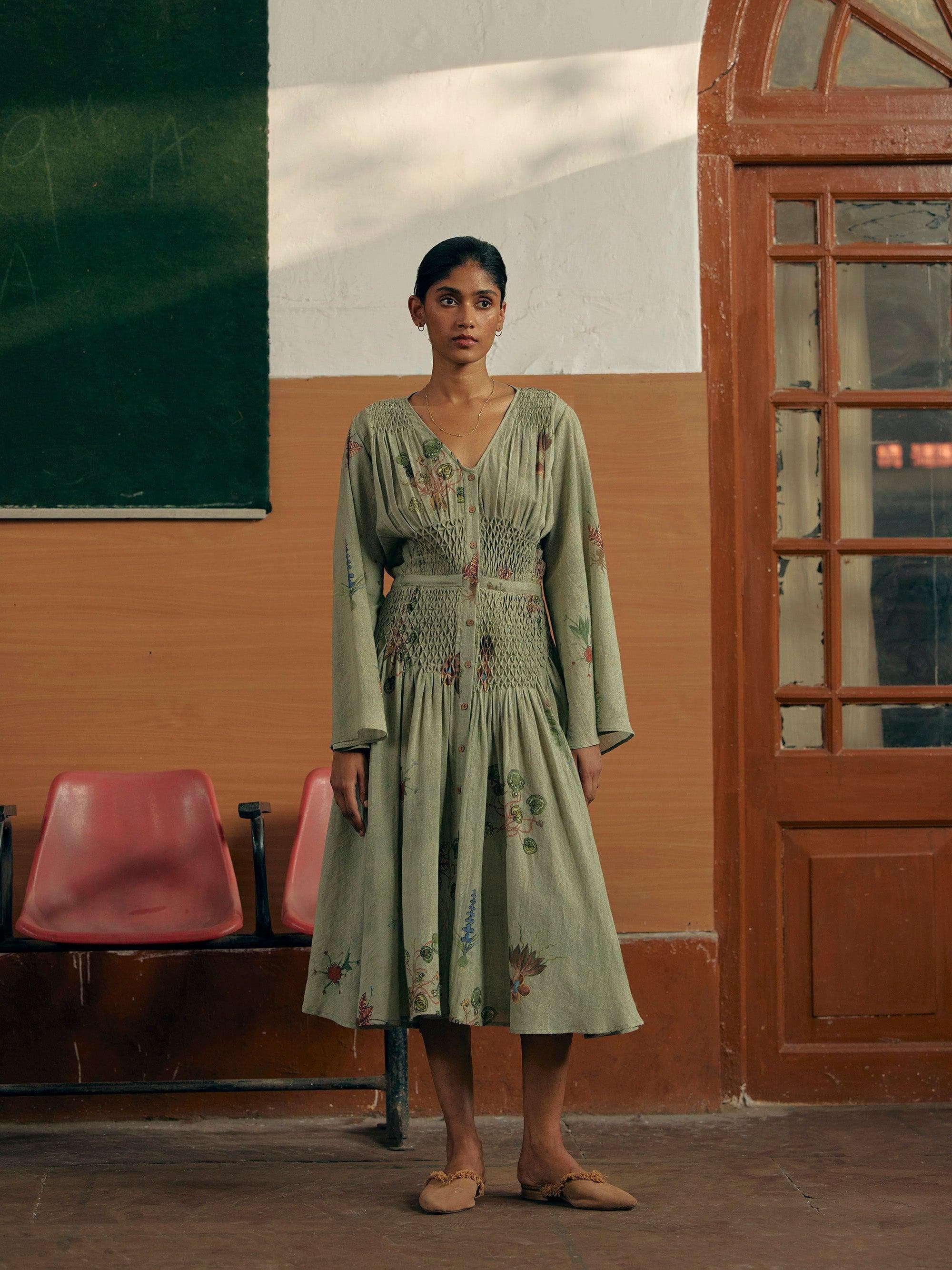
Cord is the brand that makes this argument in Indian cloth. The smocking on a Cord garment is a thirteenth-century English agricultural technique carried into twenty-first-century Indian linen by artisans in Modinagar who have been working with the brand for a decade, and the block prints come from workshops that have been cutting wooden blocks for longer than the Industrial Revolution has been a memory. Neither of these is the story; the story is what Cord does with them. The smocking is not applied as decoration, but functions as the architecture that gives the garment its three-dimensional surface, and the block print does not sit on top of a finished shape but arrives in the cloth before the pattern is cut. The craft is the ground on which the design decision stands. And the design decisions Cord is making, collection after collection, are not the decisions a heritage-preservationist brand would make. Album 91, built from the emotional register of a childhood family holiday, with Circus prints and travel-ready silhouettes, is the same brand that made Daydreamers, built from the afternoon light of a Vermeer interior and rendered in rust, indigo, and olive. Two collections, completely different emotional registers, identical craft foundation. Cord is running the Bauhaus experiment within an Indian handloom, and the result is a body of work that looks nothing like itself across seasons because the foundation is stable enough to accommodate variation. The garments are the stories wrapped in linen, and the linen is what makes the stories possible.
Kavissh and Design as Storytelling
The argument moves one more step. In 2017, the designer and writer Ellen Lupton published Design Is Storytelling, a book that extended an idea that had mostly been the province of literary theory into design practice. Lupton's argument was that any designed object, whether a poster, an app, or a chair, is structured like a narrative. It has an opening that establishes expectations, a middle that delivers evidence, and a close that resolves those expectations into meaning. The user experiences the object in time, and the designer's job is to structure that time so that the object tells the story the designer wants it to tell. The argument is usually applied to graphic and interface design, but it applies just as cleanly to cloth, and most cleanly to the Heritage Labs brand that embeds literal narratives in the garment itself.
Kavissh is that brand, where the concept precedes the piece, the piece is the vehicle for the concept, and the concept is drawn from Indian folktales, games, poetry, and living traditions. The Antara Shirt carries Birbal's khichdi on its front, and the Hastra Shirt carries the Tenali Raman horse trader story, complete with the scroll of fools' names that serves as the tale's punchline. These are not garments with stories attached; these are garments whose construction is the story. Kavissh is doing Lupton's argument in appliqué and kantha, forty pieces per design, each shirt a narrative the wearer carries into rooms where nobody else has read the same folktale. The storytelling is not a marketing frame around the product. Storytelling is the design brief, and the craft is the medium that makes it legible.
The Summer House and the Daily-Rotation Argument
The Heritage Labs argument extends beyond the statement piece. The Summer House operates one room over, where the same handwoven foundation lives inside garments designed for the Tuesday morning rather than the wedding evening. Bandra Navy Needlecord pants. Audric in Noir. The Yapa Indigo Handwoven Striped Dress. The brand's commitment is to the daily-rotation garment built from cloth that was woven by hand and never asked to disappear. What this proves, sitting beside Paher and Cord and Kavissh in the same room, is that the Heritage Labs code does not require a register of formal occasion. The cloth carries its own argument whether the wearer is going to a wedding or to a meeting, and the garment built from that cloth carries it forward into both.
Four brands, four different modes of experimentation, one shared foundation. Paher experiments with scale, refusing to produce at any volume that the handspun process cannot actually sustain. Cord experiments with emotional register, running the same craft through completely different design languages from one collection to the next. Kavissh experiments with narrative, embedding specific stories into garments so that wearing the piece is a retelling of the tale. The Summer House experiments with register itself, taking the same handwoven foundation and asking it to do daily-rotation work without losing its argument. The common ground is that none of these brands is experimenting with craft; they are experimenting from craft, with the craft as the stable foundation and the experimentation as what stands on top of it. That is the Bauhaus argument, updated for Indian textile traditions that predate the Bauhaus by several centuries and outlasted it by being harder to destroy than a European art school.
What Comes Next
What comes next is the interesting question, and it is the question every Heritage Labs brand will have to answer in the next five years. The global luxury market has spent most of the past decade hollowing out its own foundation. The European maisons are increasingly decorative exercises built on outsourced production, and the quiet luxury movement that was supposed to counter this has largely collapsed into a palette of beige basics with invisible logos. The Indian Heritage Labs brands arrive at this moment with a genuinely different proposition. They have the foundation, in craft that was not invented for a consumer market but predates consumer markets by centuries. They have the experimentation in design practices that are willing to take that craft in directions the purists would not recognize, and the revivalists would find too irreverent. They have the scale restraint, because small-batch and made-to-order are not marketing positions for these brands, but operational realities. And they have the story, because every piece of handwoven cloth that leaves the workshop arrives with a record of the hands that made it, the village it came from, and the tradition it carries forward.
The brands that will build durable international profiles over the next decade are the ones that understand the three layers of what they are actually selling. The first layer is the cloth, and the cloth has to be real, which means sourced from living craft communities with relationships that compensate the artisans at the level the work deserves. The second layer is the design, and the design has to experiment, because preservation without experimentation is taxidermy, and taxidermy is not what the international market is buying. The third layer is the story, and the story has to be true, which means the brand has to understand and be able to articulate where the craft came from, why the design is going where it is going, and what the relationship between the two actually is. A brand with all three layers is doing Heritage Labs. A brand with only clothes is a supplier. A brand with only the design is a fashion label. And a brand with only the story is marketing.
The rest is patience. The handspun cotton arrives in three weeks, the Chanderi takes longer, and the next collection will look different from this one for reasons that have very little to do with what the consumer is expecting and very much to do with what the designer has found in the fabric this season. That is the Heritage Labs rhythm, and it is the rhythm the rest of the fashion industry has spent the last forty years trying to escape. The brands doing this work now are not trying to escape it. They are building inside it, because the rhythm is what the cloth is, and the cloth is what the work is made of.
